
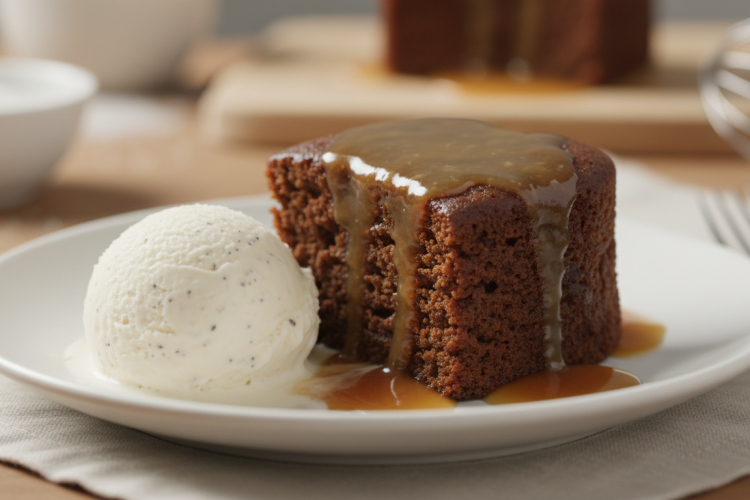
Sticky toffee pudding is a classic British dessert made from an ultra-moist date-studded sponge cake soaked in warm, buttery toffee sauce — the secret to its legendary texture is blending soaked Medjool dates into the batter, which keeps every crumb intensely soft and deeply caramel-flavored. Serve it warm with a generous pour of extra toffee sauce and a scoop of vanilla ice cream for the definitive experience.
What Is Sticky Toffee Pudding?
Sticky toffee pudding — sometimes abbreviated STP — is one of Britain’s most beloved desserts, and arguably the most requested dish on pub menus across England, Scotland, and Ireland. Despite the name, it isn’t a pudding in the American sense (like chocolate pudding). In British English, “pudding” simply means dessert, and this one is a dense, moist sponge cake made with pureed or finely chopped dates, served warm and drenched in a rich, buttery toffee sauce.
The dish became widely popular in the 1970s, though its exact origin is disputed — the Udny Arms Hotel in Aberdeenshire and the Sharrow Bay Country House Hotel in England’s Lake District both lay claim to inventing it. Regardless of its origin, it quickly spread from fine dining to pubs and home kitchens across the UK, and today it’s one of the most-searched British dessert recipes worldwide.
What makes sticky toffee pudding special isn’t complexity — the technique is straightforward — but rather the alchemy of a few humble ingredients: dates, butter, brown sugar, eggs, and flour. The dates dissolve into the batter during mixing, providing moisture, natural sweetness, and a subtly earthy depth that you can’t achieve any other way. The toffee sauce, poured both over the warm cake and pooled beneath it, turns what would be a good cake into something transcendent.

Ingredients
For the Pudding (Sponge Cake)
- 200g (1¼ cups) pitted Medjool dates, roughly chopped — Medjool dates are softer and caramel-rich; regular dried dates work but yield a slightly firmer result
- 200ml (¾ cup + 1 tbsp) boiling water
- 1 teaspoon baking soda (bicarbonate of soda) — added to the soaking water, this softens the dates and creates a slightly alkaline environment that helps with rise and deep brown color
- 85g (6 tablespoons) unsalted butter, softened at room temperature
- 175g (¾ cup packed) dark brown sugar — dark brown gives a deeper molasses flavor; light brown works for a milder version
- 2 large eggs, room temperature
- 1 teaspoon pure vanilla extract
- 175g (1⅓ cups) self-raising flour — or substitute 175g plain/all-purpose flour + 1½ tsp baking powder + ¼ tsp salt
- 1 tablespoon black treacle or molasses (optional but traditional) — adds color depth and a slight bittersweet complexity
For the Toffee Sauce
- 100g (7 tablespoons) unsalted butter
- 200g (1 cup packed) dark brown sugar
- 200ml (¾ cup + 1 tbsp) double cream or heavy cream
- 1 tablespoon black treacle or molasses (optional)
- Pinch of flaky sea salt — elevates the sauce dramatically
For serving: vanilla ice cream, clotted cream, or lightly whipped double cream.

How to Make Sticky Toffee Pudding (Step by Step)
Step 1: Soak the Dates
Place the chopped dates in a heatproof bowl or measuring jug. Pour the boiling water over them and add the baking soda. Stir briefly — it will bubble and fizz slightly. Let stand for 15–20 minutes, until the dates are completely softened and the water has turned dark brown.
Once softened, either mash with a fork for a chunkier texture (you’ll get some date pieces throughout) or blend with a hand blender for a completely smooth, uniform batter. Both approaches are authentic — the smooth version gives a more uniform crumb; the chunky version has more textural contrast. Preheat your oven to 180°C / 350°F (fan 160°C / 325°F) while the dates soak.

Step 2: Cream Butter and Sugar
In a large bowl, beat the softened butter and dark brown sugar together with an electric hand mixer or stand mixer for 3–4 minutes until pale and fluffy. The sugar won’t fully dissolve — this is normal for brown sugar, which retains some texture. Add the treacle or molasses if using, and beat to combine.
Add the eggs one at a time, beating well after each addition. Add the vanilla extract. If the mixture looks slightly curdled at this point, don’t panic — it will come together once the flour is added.
Step 3: Add Flour and Date Mixture
Sift the flour into the bowl and fold in gently with a spatula — don’t beat it, as overworking gluten makes the sponge tough. Once the flour is mostly incorporated (a few streaks are fine), pour in the warm date mixture and fold until a smooth, dark, quite liquid batter forms. It will look thinner than a typical cake batter — this is correct and what produces the moist, tender crumb.
Step 4: Bake
For individual puddings: Butter 8–10 ramekins (180–200ml capacity each) generously. Divide the batter evenly among them — fill each about two-thirds full. Place on a baking tray and bake for 20–25 minutes until risen, springy to the touch, and a skewer inserted into the center comes out clean.
For one large pudding: Butter a 20×30cm (8×12 inch) baking dish or a 23cm (9 inch) round cake tin. Pour in all the batter and bake for 35–40 minutes until risen and a skewer comes out clean. The top will be dark brown — almost mahogany colored.

Step 5: Make the Toffee Sauce
While the pudding bakes, make the toffee sauce. Combine the butter, dark brown sugar, cream, and treacle (if using) in a medium saucepan over medium heat. Stir constantly until the butter melts and the sugar dissolves completely. Bring to a gentle boil and simmer for 3–4 minutes, stirring occasionally, until the sauce thickens slightly and coats the back of a spoon. Remove from heat, stir in the flaky sea salt, and set aside.
The sauce can be made up to 3 days ahead and reheated gently on the stovetop or in the microwave. It thickens considerably as it cools — thin it with a splash of cream when reheating if needed.

Step 6: The Soak (The Most Important Step)
This step is what separates restaurant-quality sticky toffee pudding from an ordinary dark cake. As soon as the puddings come out of the oven, poke them all over with a skewer or fork — 10–15 pokes per pudding. Immediately pour a generous amount of warm toffee sauce over each one, letting it soak into the holes and pool around the edges. Let sit for 5 minutes to absorb.
When serving, reheat the remaining sauce and pour more over each pudding at the table. The pudding should be served swimming in sauce — not drizzled, not lightly coated. Served.

Make-Ahead, Storage, and Reheating
Make-Ahead Tips
Sticky toffee pudding is one of the most make-ahead-friendly British desserts. Bake the puddings fully, let cool, then wrap tightly in cling film. Refrigerate for up to 3 days, or freeze for up to 2 months. Make the toffee sauce separately and store in a sealed jar in the refrigerator for up to 1 week. At serving time, reheat the puddings and sauce separately, then assemble and serve. The flavors actually deepen overnight — many restaurants serve the day-old version intentionally.
Reheating
From refrigerator: Microwave individual puddings for 1–2 minutes on medium power, or reheat covered in foil in a 160°C / 325°F oven for 15 minutes.
From frozen: Thaw overnight in the refrigerator, then reheat as above. Or microwave straight from frozen on 50% power in 2-minute intervals until heated through.
Toffee sauce: Reheat in a saucepan over low heat, stirring, or in a microwave in 30-second bursts. Add a splash of cream if it has thickened too much.
Variations and Serving Ideas
Classic British Pub Style
Serve in a deep bowl with the pudding sitting in a small pool of toffee sauce, topped with a large scoop of vanilla clotted cream ice cream. This is the definitive British pub presentation and the one most people imagine when they think of STP.
Espresso Sticky Toffee Pudding
Add 1 tablespoon of instant espresso powder dissolved in 1 tablespoon hot water to the batter along with the date mixture. Add a shot of espresso to the toffee sauce as well. The coffee amplifies the bittersweet caramel notes without tasting coffee-forward — it acts like salt in chocolate, making all the other flavors more vivid.
Salted Caramel Version
Double the salt in the toffee sauce (1 teaspoon flaky sea salt instead of a pinch) and add ¼ teaspoon of smoked sea salt on top of each serving. Serve with crème fraîche instead of ice cream. The contrast between the intensely sweet cake and the salty sauce is extraordinary, similar to the balance in our salted caramel churros recipe.
Sticky Toffee Banana Pudding Fusion
Replace half the dates with 2 very ripe mashed bananas. The banana adds fruity sweetness and makes the sponge even more moist. Serve with sliced fresh banana on top and the standard toffee sauce. This fusion approach is reminiscent of our easy banana pudding recipe, combining two comfort dessert classics.
Mini Sticky Toffee Pudding Cupcakes
Pour the batter into a greased 12-cup muffin tin instead of ramekins. Bake for 18–20 minutes. Once cooled slightly, hollow out a small well in the center of each cupcake with a teaspoon and fill with warm toffee sauce. Top with a swirl of whipped cream. These are excellent for dinner parties and holiday gatherings — the individual portions are elegant and everyone gets their own pudding.

Tips for the Best Sticky Toffee Pudding
Use Medjool Dates, Not Regular Dried Dates
Medjool dates are sometimes called the “king of dates” for good reason — they’re larger, softer, and have a rich caramel flavor that dried Deglet Noor dates can’t match. According to Healthline, Medjool dates are higher in natural sugars and moisture content, which contributes directly to the moist, tender crumb of the pudding. If you can only find regular dried dates, soak them for 30 minutes instead of 15.
Don’t Skip the Baking Soda Soak
Adding baking soda to the boiling date water does two things: it softens the dates more rapidly (the alkaline environment breaks down the pectin in the fruit cell walls), and it contributes to the deep brown Maillard reaction color in the baked cake. Don’t substitute baking powder here — the chemistry is different.
Don’t Overbake
Sticky toffee pudding should be just barely set in the center — a skewer should come out clean but the cake should still have a slight spring. If you wait for it to feel completely firm, it will dry out. The toffee sauce soak adds back moisture, but if the cake is over-dried in the oven, not even sauce can rescue it fully.
Make Extra Sauce
The toffee sauce recipe above makes enough to soak the puddings AND serve alongside. You should always have extra sauce — the defining characteristic of a great sticky toffee pudding is that it arrives drowning in sauce. Some pubs make a 1.5x batch of sauce for this reason. The sauce keeps well, so there’s no reason to be conservative.
Pair It Right
The cold-hot contrast of warm pudding + cold ice cream is the classic for a reason. The vanilla fat in clotted cream or good vanilla ice cream cuts through the intense sweetness of the toffee sauce and provides textural contrast. Crème fraîche (slightly tangy) is excellent for those who find the classic too sweet. Avoid chocolate ice cream — it overwhelms the date and caramel flavors in the pudding itself. If you enjoy warm desserts with creamy accompaniments, our easy chocolate mousse and easy panna cotta recipe offer equally impressive results with minimal effort.
Frequently Asked Questions
Is sticky toffee pudding gluten free?
Not in the traditional recipe — it uses wheat flour. However, it can easily be made gluten free by substituting a 1:1 gluten-free flour blend for the self-raising flour, plus 1½ teaspoons of baking powder and ½ teaspoon of xanthan gum (if your blend doesn’t already contain it). The moisture from the dates helps compensate for the slightly drier texture that GF flours sometimes produce, so this recipe is actually one of the better candidates for a GF conversion.
Can I make sticky toffee pudding without dates?
The dates are the foundation of the recipe — they provide moisture, sweetness, and the characteristic earthy depth. Without them, you have a different dessert. The closest substitution is prunes (dried plums), which have a similar moisture content and sweetness. Use the same weight and follow the same soaking process. The flavor will be slightly fruitier and less caramel-forward, but still excellent. Figs are another option, though they produce a nuttier, seedier result.
Does sticky toffee pudding taste like dates?
Not obviously. If you didn’t know dates were an ingredient, you might not identify them — the flavor reads more as a rich, warm caramel-molasses depth rather than “fruity.” The dates dissolve into the batter and merge with the dark brown sugar and treacle to create a deeply savory-sweet backdrop. People who don’t like eating dates whole often love sticky toffee pudding precisely because the date flavor transforms so completely during baking.
What’s the difference between sticky toffee pudding and toffee pudding?
“Toffee pudding” without “sticky” in the name typically refers to a similar cake that may or may not include dates, often with a less saturated sauce. “Sticky” specifically implies the generous sauce soak technique that makes the outside of the cake glossy, tacky, and deeply caramelized. In practice, the terms are used interchangeably in most modern recipes, with “sticky toffee pudding” being the internationally recognized full name.
Why is my sticky toffee pudding dry?
Three common causes: (1) Overbaking — pull it from the oven as soon as a skewer comes out clean, even if it feels slightly underdone; (2) Not enough toffee sauce soak — poke many holes and apply sauce liberally while the pudding is still hot; (3) Wrong dates — dried Deglet Noor dates have significantly less moisture than Medjool. Use Medjool whenever possible. If your pudding has already dried out, pour warm sauce over it, cover with foil, and place back in a low oven (150°C / 300°F) for 10 minutes — the steam will help rehydrate it.