
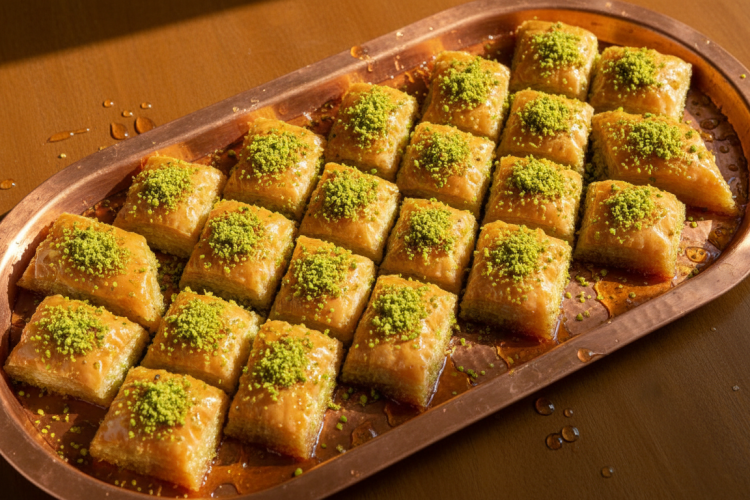
Baklava most likely originated in the imperial kitchens of the Ottoman Empire in Istanbul (modern-day Turkey), where it was refined into its layered form during the 15th century — though its earliest roots trace back to ancient Mesopotamia, Central Asia, and the Byzantine Empire, all of which contributed versions of nut-filled pastry to the recipe we know today.
Ancient Roots of Layered Nut Pastry
The story of baklava starts long before phyllo dough or Ottoman kitchens. The core concept — thin layers of pastry, nuts, and sweetener — appears independently across several ancient cultures:
- Ancient Mesopotamia (modern Iraq/Syria): Honey-and-nut cakes appear in records dating to the 8th century BC. Assyrian households baked thin layers of dough with pistachios and walnuts, sweetened with honey.
- Ancient Greece: The Greeks made gastris — a layered pastry with honey and nuts — and kopte sesamis, a sesame-and-honey confection. Greek traders brought phyllo-making techniques across the Mediterranean.
- Central Asia (Turkic and Mongolian nomads): Nomadic cultures across the steppes made a dish called baqlava from layered bread and nuts during long journeys. The word “baqlava” is believed to be Mongolian in origin.
The Ottoman Empire: Baklava Gets Its Shape
The baklava we recognize today — tissue-thin phyllo, clarified butter, a nut filling, and a sugar or honey syrup — was fully developed in the kitchens of the Topkapi Palace in Constantinople (now Istanbul) during the reign of Sultan Suleiman the Magnificent in the 15th-16th centuries.
The palace employed hundreds of pastry chefs whose sole job was to perfect this confection. The Baklava Alayı (Baklava Procession) became a formal royal tradition: during Ramadan, the Sultan would personally oversee the procession of baklava trays from the palace kitchens to the Janissary soldiers — a symbol of imperial generosity and military loyalty.
This cemented baklava’s status not just as a food, but as a political and cultural institution. It was distributed to the army, presented at religious celebrations, and gifted to foreign dignitaries.
Who Claims Baklava? The Regional Debate
Baklava is one of the most contested foods in the world — Turkey, Greece, Lebanon, Syria, Armenia, and several Balkan nations all lay historical and cultural claim to it. Here’s the landscape:
| Country | Their Claim |
|---|---|
| Turkey | Fully developed the layered phyllo technique in Ottoman imperial kitchens; Gaziantep baklava is UNESCO-recognized (2013) |
| Greece | Ancient Greek pastry traditions predate the Ottomans; Greek baklava uses honey and walnuts |
| Lebanon/Syria | Arab traders were making nut-and-honey pastries centuries before the Ottoman Empire; rose water syrup is distinctly Levantine |
| Armenia | Armenian pastry traditions contributed significantly during Ottoman rule; distinct clove-spiced variant |
| Azerbaijan | Diamond-cut pakhlava is a national dish; saffron, cardamom, and hazelnuts distinguish it |
Most food historians agree: baklava is a shared cultural heritage with no single origin country. The Ottoman Empire was a melting pot that synthesized traditions from across three continents.
How Baklava Spread Around the World
As the Ottoman Empire expanded and eventually declined, baklava spread along trade routes, through migration, and via cultural exchange:
- North Africa: Brought by Ottoman expansion across Egypt and the Maghreb; adapted with orange blossom water and pine nuts in Tunisia
- The Balkans: Bosnia, Serbia, Bulgaria, and Albania all developed local variants during Ottoman rule
- The United States: Greek, Lebanese, and Armenian immigrants brought baklava to America in the late 19th and early 20th centuries. Today it’s widely available at Middle Eastern and Greek bakeries nationwide.
- Global pop culture: The rise of Mediterranean and Middle Eastern cuisine in Western markets through the 2000s-2020s brought baklava to mainstream grocery stores and dessert menus worldwide.
Regional Styles of Baklava Today
Despite the shared name, baklava varies dramatically by region:
| Style | Nuts | Sweetener | Distinctive Notes |
|---|---|---|---|
| Turkish (Gaziantep) | Pistachios | Sugar syrup | Very thin phyllo, minimal sweetener, pistachio-forward |
| Greek | Walnuts | Honey | Cinnamon-spiced, honey-soaked, often with cloves |
| Lebanese/Syrian | Pistachios or mixed | Rose water syrup | Floral, lighter, often diamond-cut |
| Azerbaijani Pakhlava | Hazelnuts, walnuts | Honey or saffron syrup | Diamond-shaped, saffron-tinted, cardamom-spiced |
| Algerian | Almonds | Orange blossom water | Crispy, lighter syrup, citrus-floral finish |
For more on the wonderful diversity of global sweets, check out our Global Dessert Traditions guide and our roundup of traditional Naw-Ruz desserts — which features several baklava variants from Central Asian and Levantine traditions.
Cultural and Religious Significance
Baklava has always been more than dessert. Across its many home regions, it carries deep cultural weight:
- Ramadan and Eid: In Turkey, Lebanon, and across the Arab world, baklava is central to Ramadan celebrations and Eid al-Fitr feasts. Families make trays to share with neighbors.
- Nowruz (Persian New Year): Baklava and pakhlava are traditional Nowruz sweets in Iran and Azerbaijan.
- Weddings and births: In many Balkan and Middle Eastern cultures, baklava is served at life celebrations as a symbol of prosperity and sweetness.
- Hospitality: Offering baklava to a guest is a gesture of respect across most cultures where it is made.
The Art of Layering: Baklava’s Technical Challenges
Baklava’s signature layered structure is both its most distinctive feature and its greatest technical challenge. Achieving the perfect balance of crisp, buttery phyllo, crunchy nuts, and a glossy honey‑or‑syrup glaze requires a blend of precision, patience, and a little bit of reverence for centuries‑old techniques. The process begins with the phyllo dough itself—a paper‑thin sheet made from flour, water, and a touch of oil. Because phyllo is so delicate, it can tear or dry out in an instant, turning a potential masterpiece into a frustrating mess. For home bakers, the first step is to select high‑quality, frozen phyllo that has been properly stored; the best options are often found in the freezer aisle of specialty grocery stores. Once thawed, keep the sheets covered with a damp kitchen towel to prevent them from drying out while you work.
When you start layering, the secret is to brush each sheet lightly with melted butter (or clarified butter for a richer flavor) before adding the next. This thin coating creates a barrier that keeps the layers separate during baking, resulting in that coveted flaky texture. A common mistake is using too much butter, which can cause the pastry to become soggy once the syrup is poured over the hot baklava. For a deeper dive into handling phyllo, check out our detailed guide How to Choose and Work with Phyllo Dough. Once the layers are stacked—usually 10 to 12 sheets for a standard tray—sprinkle a generous mixture of finely chopped nuts (traditionally pistachios, walnuts, or almonds) that have been lightly toasted to bring out their natural oils. The nuts are often seasoned with a pinch of ground cinnamon, cardamom, or even a whisper of orange zest to add complexity.
After the baklava is baked to a golden brown, the final step is the syrup. Hot honey or a simple sugar‑water syrup infused with lemon juice is poured over the still‑warm pastry, allowing it to soak in without making the layers soggy. The timing is crucial: if the syrup is too cool, it will sit on top; if it’s too hot, it can melt the buttered layers. For more on the science behind this delicate balance, see Wikipedia’s entry on phyllo dough, which explains how the starches gelatinize and crisp during baking. Mastering these technical nuances transforms a simple dessert into a show‑stopping centerpiece that honors baklava’s storied past.
Baklava in Modern Cuisine: Innovations and Global Twists
While traditional baklava remains a beloved staple across the Middle East, the Balkans, and the Mediterranean, contemporary chefs are reimagining the classic dessert to suit evolving palates and dietary trends. One of the most exciting developments is the use of alternative sweeteners and flavor infusions that respect the original’s sweet‑nutty profile while adding a fresh twist. For instance, maple syrup or agave nectar can replace honey for a vegan‑friendly version, and pomegranate molasses adds a tangy depth that pairs beautifully with pistachios. Our post Maple Syrup vs. Honey: Which Sweetener Wins? explores how these swaps affect texture and flavor.
Beyond sweeteners, baklava is finding its way into savory territory. Some innovative kitchens are layering phyllo with spiced lamb, feta, and herbs, then finishing the dish with a drizzle of yogurt‑mint sauce—a nod to the pastry’s versatility. Others are incorporating exotic spices such as sumac, za’atar, or even smoked paprika to create a bold, aromatic experience. In the United States, you’ll see baklava-inspired cupcakes, ice‑cream sandwiches, and even cocktail garnishes that use crumbled baklava as a crunchy topping. These modern adaptations keep baklava relevant in a culinary landscape that prizes creativity and fusion.
Even the presentation has evolved. Instead of the traditional diamond cuts, chefs now serve baklava in bite‑size tartlets, rolled “baklava rolls,” or layered parfaits that alternate phyllo shards with whipped cream and fruit compote. According to Serious Eats, successful innovation respects the core techniques—proper layering, buttering, and syruping—while daring to experiment with new textures and flavors. Whether you’re a purist who swears by the classic walnut‑and‑honey version or an adventurous foodie eager to try a pistachio‑rose‑scented, vegan baklava, the dessert’s adaptability proves that its legacy is far from static.
The Science of Baklava: Understanding the Chemistry Behind the Flaky Layers
The delicate, airy crunch of baklava’s phyllo layers is a marvel of food chemistry. When the butter‑coated sheets enter a hot oven, the water in the dough rapidly evaporates, creating steam that lifts the layers and creates tiny air pockets. Simultaneously, the starches in the flour gelatinize, forming a firm yet tender matrix that holds the structure together. As the temperature climbs, the Maillard reaction kicks in, turning the surface a deep golden brown and developing the complex, nutty aromas we associate with a perfectly baked baklava.
Temperature and humidity play pivotal roles. A dry oven ensures that the moisture evaporates quickly, preventing sogginess, while a moderate humidity level keeps the phyllo from cracking during handling. The butter used between layers also contributes to the final texture; clarified butter, with its higher smoke point, yields a crisper finish than regular butter, which contains milk solids that can brown too quickly. For a deeper dive into the science of baking, explore the Science of Baking series on Serious Eats, which breaks down how heat, fat, and moisture interact in pastries.
When the hot syrup is poured over the freshly baked baklava, a fascinating diffusion process begins. The syrup, typically a mixture of sugar, water, honey, and citrus juice, is poured while still warm but not boiling. This temperature differential allows the syrup to be absorbed primarily by the outermost layers, where the pores are most open, while the inner layers stay relatively dry, preserving that coveted crunch. Over time, capillary action draws the syrup deeper, creating a harmonious balance of sweet, sticky, and crisp. The FDA’s food safety guidelines remind bakers to keep syrup temperatures above 160°F (71°C) to prevent bacterial growth, ensuring that the dessert remains both delicious and safe.
Frequently Asked Questions
Did Greeks or Turks invent baklava?
Neither invented it alone. Baklava evolved from ancient traditions across Mesopotamia, Persia, Central Asia, and Greece before being refined in the Ottoman Empire. Both Greek and Turkish baklava traditions are historically significant and reflect centuries of parallel development.
What does “baklava” mean?
The etymology is debated. Most scholars believe the word is Mongolian or Old Turkic in origin, possibly from the word baγla- meaning “to tie or wrap.” Others suggest an Arabic origin from the root meaning “to soak.”
When was baklava first recorded in writing?
The earliest written recipe resembling baklava appears in an Ottoman source from around 1453. However, layered nut pastries appear in food records much earlier — as far back as the 8th century BC in Assyrian texts.
Is baklava from the Middle East or Mediterranean?
Both. Baklava is culturally embedded in both regions — the Middle East (Lebanon, Syria, Iraq, Turkey) and the Eastern Mediterranean (Greece, Bulgaria, Cyprus). Its identity spans both geographic zones.
How should baklava be stored?
Baklava keeps well at room temperature for up to 2 weeks in an airtight container. Refrigeration can make the phyllo soggy over time. For longer storage, freeze it in an airtight container for up to 3 months. Our full guide to storing baklava covers every scenario in detail.