
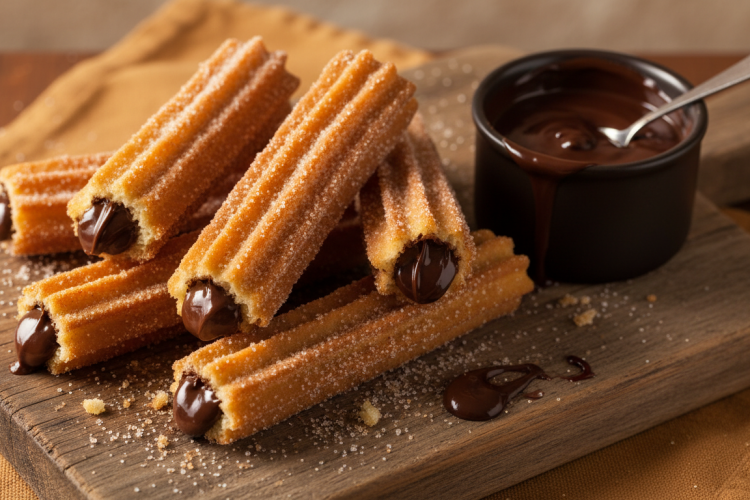
Brazilian churros are thicker, crispier, and filled with creamy chocolate brigadeiro — unlike Spanish churros which are typically served plain with dipping sauce. This recipe walks you through the traditional Brazilian street-food technique: a sturdy choux-style dough, deep-fried to a golden crunch, then injected with homemade brigadeiro filling and rolled in cinnamon sugar. The result is a showstopper dessert that tastes like carnival season any day of the week.

What Makes Brazilian Churros Different
Brazilian churros (churros brasileiros) evolved quite differently from their Spanish and Mexican counterparts. In Brazil, churros are a beloved street food sold from carts and kiosks in parks, beaches, and feiras (open markets). The key distinctions are structural: Brazilian churros are typically shorter and fatter, with a thicker wall of fried dough that can hold a generous filling without bursting. They’re almost always filled — brigadeiro chocolate cream is the classic, but doce de leite (caramel) and cream cheese variants are also popular.
According to Wikipedia’s entry on churros, the pastry arrived in Latin America via Spanish colonizers in the 16th century, but each country adapted it to local tastes and ingredients. Brazil’s version reflects the country’s love for brigadeiro — a confection made from condensed milk and cocoa powder that is itself a Brazilian original, invented in the 1940s. The combination of churro + brigadeiro is quintessentially Brazilian and unlike anything you’ll find elsewhere.
Ingredients You’ll Need
This recipe makes approximately 12–14 Brazilian churros, enough to serve 4–6 people. The dough uses a choux-style base (water, butter, flour, eggs) which gives the churros their characteristic crispy exterior and slightly chewy interior.
For the Churro Dough
- 1 cup (240ml) water
- ½ cup (113g) unsalted butter, cut into cubes
- 1 tablespoon granulated sugar
- ½ teaspoon fine salt
- 1 cup (125g) all-purpose flour, sifted
- 3 large eggs, room temperature
- Vegetable oil for deep frying (about 4 cups / 1 litre)
For the Cinnamon Sugar Coating
- ½ cup (100g) granulated sugar
- 1½ teaspoons ground cinnamon
For the Brigadeiro Filling
- 1 can (395g / 14oz) sweetened condensed milk
- 3 tablespoons unsweetened cocoa powder
- 1 tablespoon unsalted butter
- Pinch of salt
Equipment needed: Deep heavy-bottomed saucepan or Dutch oven, candy/deep-fry thermometer, piping bag with large star tip (1M or 2D), second piping bag with a long thin filling tip (or a skewer to make a channel), wire cooling rack, and a shallow dish for cinnamon sugar rolling.
Step 1: Make the Brigadeiro Filling
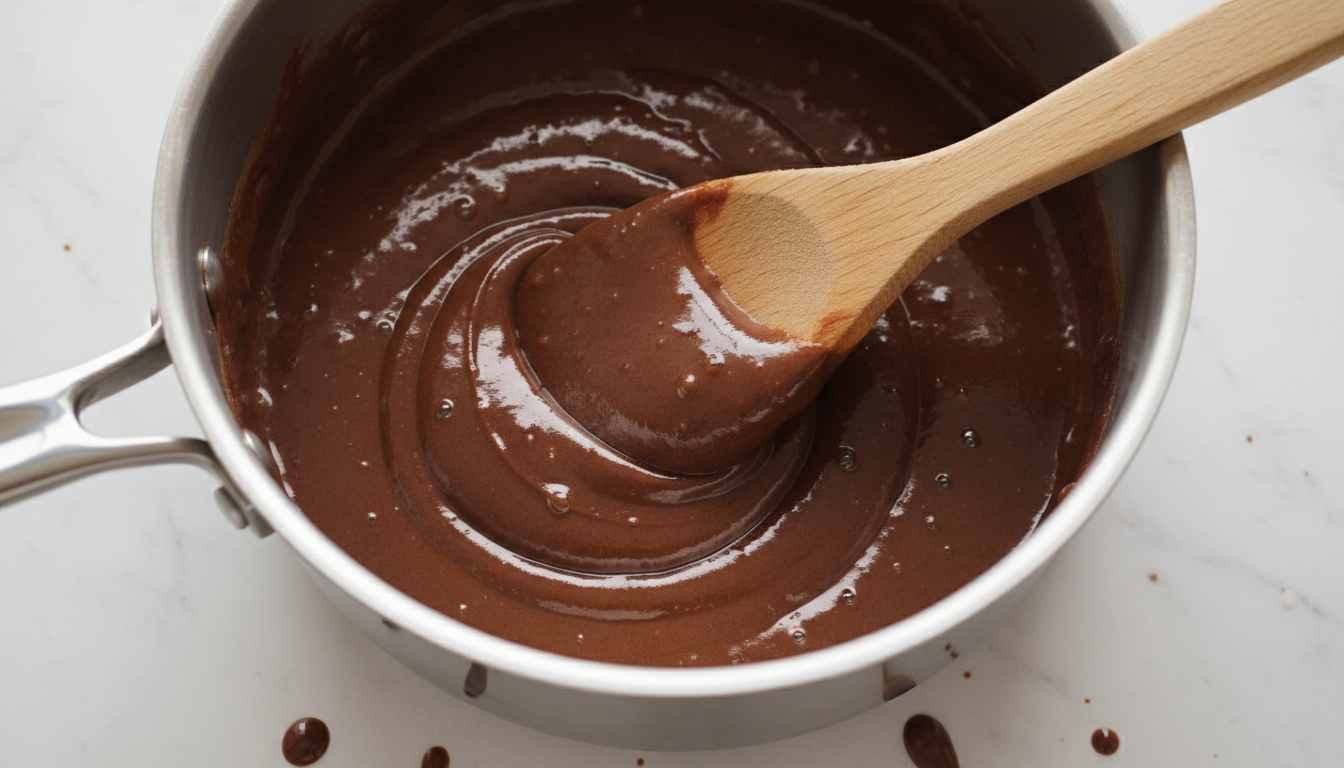
Start with the brigadeiro because it needs time to cool and thicken to a pipeable consistency. Combine the condensed milk, cocoa powder, butter, and salt in a medium heavy-bottomed saucepan over medium-low heat. Stir constantly with a wooden spoon or silicone spatula — do not walk away, as brigadeiro catches and burns quickly on the bottom.
Cook for 10–15 minutes, stirring continuously, until the mixture thickens noticeably and starts to pull away from the sides of the pan. You’ll know it’s ready when you drag the spatula across the bottom and the brigadeiro holds a clear line for 2–3 seconds before flowing back. Remove from heat and pour into a heatproof bowl. Press plastic wrap directly onto the surface to prevent a skin forming. Let cool completely — at least 1 hour at room temperature, or 30 minutes in the refrigerator.
Once cooled, transfer to a piping bag fitted with a long thin tip (a Bismarck/filling tip works best). If you don’t have a filling tip, use a chopstick or skewer to bore a channel through the churro from one end, then fill with a regular round tip. For more filling ideas and techniques, see our Bavarian Cream Churros post which covers the filling-injection method in detail.
Step 2: Make the Churro Dough
Combine water, butter, sugar, and salt in a medium saucepan. Bring to a full rolling boil over medium-high heat, stirring occasionally to melt the butter. The moment it boils, remove from heat and add all the flour at once. Stir vigorously with a wooden spoon until a smooth dough ball forms and pulls away from the sides of the pan. This step is critical — you want all the flour fully incorporated before it cools.
Return the pan to medium heat and stir continuously for about 2 minutes. This step dries out excess moisture and ensures the churros don’t absorb excessive oil during frying. You’ll see a thin film form on the bottom of the pan — that’s a good sign the dough is dry enough. Remove from heat and let the dough cool for 5 minutes until it’s warm but no longer steaming hot.
Add the eggs one at a time, beating vigorously after each addition. The dough will look like it’s separating at first — keep stirring and it will come together. After all three eggs are incorporated, the dough should be smooth, glossy, and thick enough to hold its shape when piped, but pliable. Transfer to a piping bag fitted with a large open star tip.

Step 3: Fry the Churros
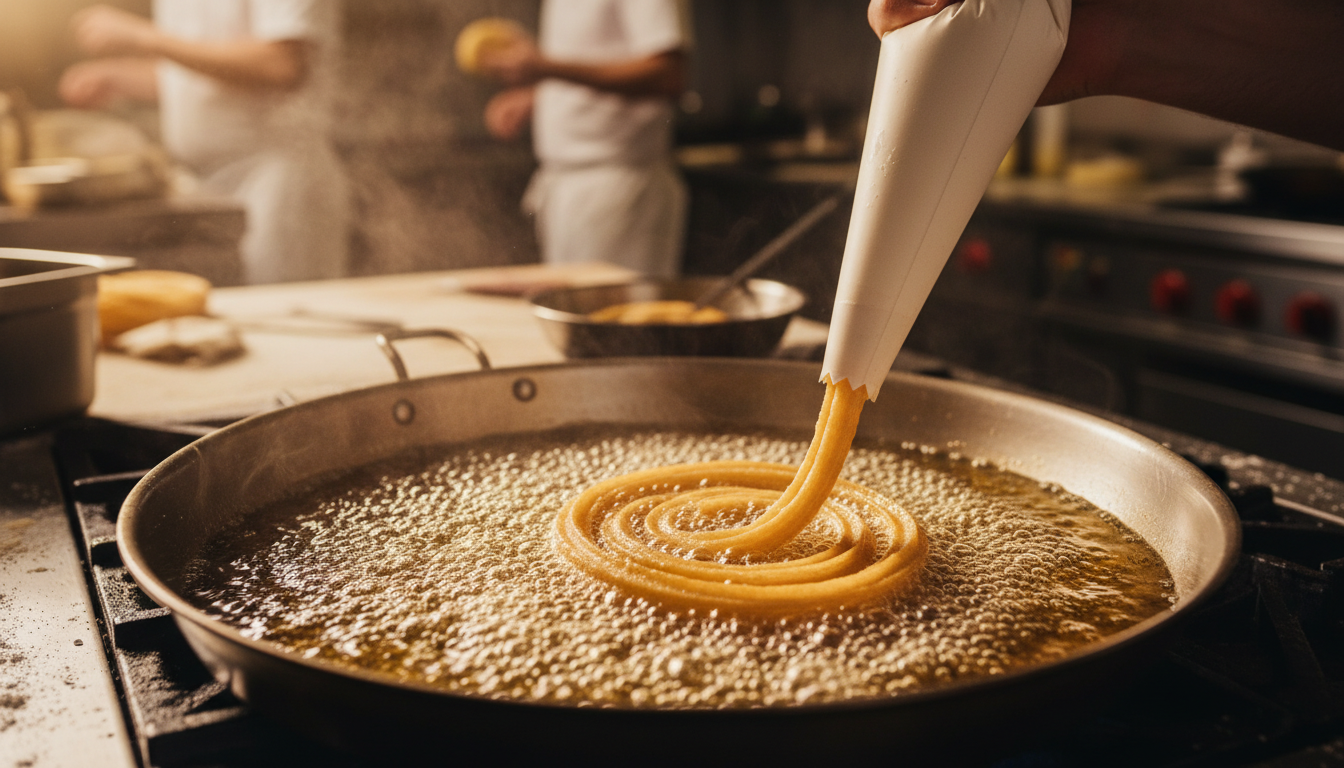
Pour vegetable oil into a deep heavy-bottomed pot to a depth of at least 3 inches (7cm). Heat over medium-high until a thermometer reads 350°F (175°C). Maintaining consistent oil temperature is the most important factor in getting Brazilian churros right — too cool and they absorb oil and turn greasy; too hot and the outside burns before the inside cooks through.
Pipe the dough directly into the oil in 4–5 inch (10–12cm) lengths, snipping each one with clean kitchen scissors as you go. Brazilian churros are shorter than their Spanish counterparts — the compact size makes filling much easier and ensures even frying. Fry 3–4 at a time without crowding. Turn with tongs after 2–3 minutes when the underside is deep golden. Total fry time is approximately 4–5 minutes per batch.
Transfer to the wire cooling rack (not paper towels — paper towels trap steam and soften the crust). While still hot, roll each churro in the cinnamon sugar mixture, coating all sides. Let them rest on the rack for at least 5 minutes before filling — filling a piping-hot churro will melt the brigadeiro and create a mess.
Step 4: Fill with Brigadeiro
Insert the filling tip into one end of the churro, pushing it about halfway in. Squeeze the piping bag gently while slowly withdrawing the tip — this distributes the filling evenly through the length of the churro rather than creating a pocket at one end. You’ll feel slight resistance as the filling displaces the air inside; stop squeezing the moment you see brigadeiro start to emerge from the opening (that means it’s full).

If you don’t have a filling tip, use a chopstick to bore a channel from each end toward the center (meeting in the middle), then use a small round tip to pipe the brigadeiro in from both ends. It’s slightly messier but works perfectly well. For a party presentation, you can also serve the churros alongside a small bowl of warm brigadeiro as a dipping sauce — this approach works especially well if you’re making a large batch. See how we did this with our Caramel Churros recipe for dipping sauce presentation ideas.

Tips for Perfect Brazilian Churros Every Time
- Use a thermometer. Oil temperature matters more than almost any other variable. A clip-on candy thermometer is inexpensive and makes the difference between greasy and crisp.
- Dry the dough enough. Stirring the dough over heat for 2 minutes after it forms seems tedious but it’s essential — wetter dough absorbs more oil and produces a soft, greasy churro.
- Don’t crowd the pot. Adding too many churros at once drops the oil temperature sharply. 3–4 at a time is the maximum for a standard pot.
- Cool before filling. Hot churros will melt the brigadeiro and you’ll end up with a soggy mess. 5 minutes on a rack is the minimum; 10 minutes is better.
- Brigadeiro consistency matters. Brigadeiro that’s too warm will be runny and leak out. It should be thick enough to hold its shape — like a very soft ganache. If yours is too thin, return it to low heat and stir for another 3–5 minutes.
- Make the brigadeiro first. Always. It needs to cool and thicken while you make the dough and fry.
Filling Variations
While chocolate brigadeiro is the classic, Brazilian churros are also sold with several other popular fillings. Here are the most common variations you’ll find at Brazilian street markets:
- Doce de leite (caramel) — thick Brazilian caramel, slightly more fluid than dulce de leche but equally rich. Use a jarred version or make your own by slow-cooking condensed milk.
- Cream cheese (creme de queijo) — a sweetened cream cheese filling that’s tangy and rich. Mix 200g softened cream cheese with 3 tablespoons powdered sugar and a splash of vanilla.
- White chocolate brigadeiro (brigadeiro branco) — same technique as dark brigadeiro but using white chocolate instead of cocoa powder. Sweet, rich, and pairs beautifully with the cinnamon exterior.
- Nutella or chocolate hazelnut — a non-traditional but popular modern variant; simply warm Nutella slightly to a pipeable consistency.
For more filling inspiration, our Churro Tres Leches Cake and Matcha Churros both use creative flavor combinations that could work equally well as fillings in this Brazilian format.
Serving and Storage
Brazilian churros are best served within 30 minutes of frying and filling — the cinnamon sugar coating starts to absorb moisture over time, and the crust softens. If you’re making them for a party, fry and coat all the churros ahead of time, then fill them just before serving. The unfilled, uncoated fried churros can be held on a rack in a 200°F (95°C) oven for up to 30 minutes without losing too much crispness.
Leftover churros (if there are any) can be stored in an airtight container at room temperature for up to 1 day. Reheat in an air fryer at 375°F (190°C) for 3–4 minutes to restore some crispness. Refrigerating filled churros is not recommended — condensation will soften the exterior rapidly. The brigadeiro filling on its own keeps well refrigerated for up to 1 week in a sealed container.
More Churro Recipes to Try
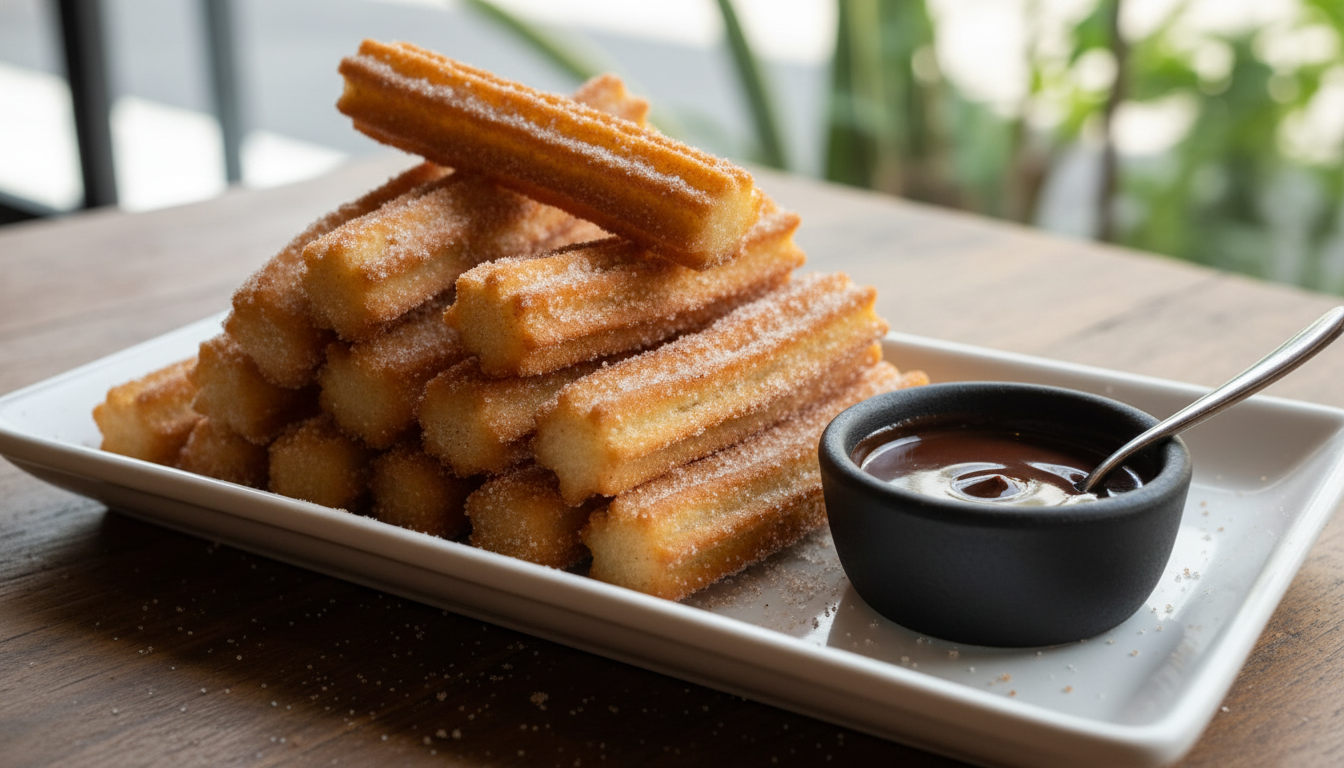
Once you’ve mastered Brazilian churros, there’s a whole world of churro variations to explore. Our Salted Caramel Churros use the same choux-style dough with a buttery salted caramel sauce that rivals anything from a street cart. The Ube Churros take the concept in a completely different direction with vibrant purple ube dough and a white chocolate dip — a Filipino-Brazilian mashup that’s spectacular at parties.
Frequently Asked Questions
What is the difference between Brazilian churros and regular churros?
Brazilian churros are shorter, fatter, and always filled — most commonly with chocolate brigadeiro or doce de leite. Spanish and Mexican churros are typically longer, thinner, and served alongside a separate dipping sauce rather than filled internally. Brazilian churros also tend to use a slightly thicker dough with eggs, similar to choux pastry, which gives them a sturdier wall capable of holding filling without collapsing.
Can I make Brazilian churros without a piping bag?
Yes — use a large zip-lock bag with one corner snipped off as a substitute piping bag. For the star pattern on the exterior, you need a star tip; a plain round tip or bag corner will produce smooth-sided churros that look slightly different but taste identical. For filling without a dedicated filling tip, use a chopstick or skewer to bore a channel through the churro from both ends, then pipe the brigadeiro in with a round tip.
Why are my churros greasy?
Greasy churros are almost always caused by oil that’s too cool (below 340°F / 171°C). When the oil temperature drops, the dough absorbs it rather than frying crisply. Other contributing factors: dough that wasn’t dried enough in the pan before adding eggs, or crowding the pot (which drops oil temperature sharply). Use a thermometer and fry in small batches of 3–4 at a time.
Can I bake Brazilian churros instead of frying?
Technically yes, but the results are quite different. Baked churros won’t achieve the same golden crunch — they’ll be more like a soft éclair shell than a crispy fried churro. If you prefer a lighter option, an air fryer at 375°F (190°C) for 12–15 minutes (sprayed with oil) gets closer to the fried texture than a standard oven, though still not identical. For the traditional Brazilian street-food experience, frying is the method.
Can I make the brigadeiro filling ahead of time?
Yes — brigadeiro can be made up to 5 days ahead and stored in a sealed container in the refrigerator. Before using, let it come to room temperature for 20–30 minutes and stir well; it should loosen slightly as it warms. If it’s still too thick to pipe, set the container in a bowl of warm water for 5 minutes and stir again. Don’t microwave brigadeiro directly — it heats unevenly and can seize.