
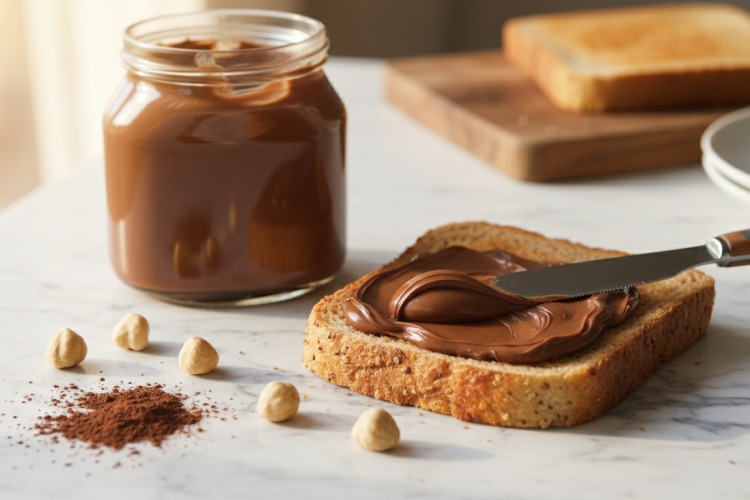
Nutella is not certified gluten-free, but its ingredient list does not contain any gluten-containing ingredients — it is made from sugar, palm oil, hazelnuts, skim milk, cocoa, lecithin, and vanillin. Ferrero, the manufacturer, does not label Nutella as gluten-free in the United States, and the product is produced in facilities that may handle wheat and other allergens, making it a potential cross-contamination risk for people with celiac disease.

What Is Nutella Made Of?
Nutella is a hazelnut cocoa spread manufactured by Ferrero, an Italian confectionery company. It was first introduced in 1964 and has since become one of the most recognized spread brands globally. The recipe has remained fairly consistent, with the current U.S. formulation containing the following ingredients:
- Sugar — The primary ingredient by weight
- Palm oil — Gives Nutella its spreadable, creamy texture at room temperature
- Hazelnuts — About 13% of the product; the distinctive flavor base
- Skim milk — Adds creaminess and dairy richness
- Cocoa — About 7.4% cocoa; provides the chocolate flavor
- Lecithin as emulsifier (soy) — Helps bind fat and water components
- Vanillin — Artificial vanilla flavoring
Notably absent from this list: wheat, barley, rye, oats, or any other gluten-containing grain. On the surface, Nutella’s ingredient list reads as gluten-free. The complication arises not from the ingredients themselves but from manufacturing environment and certification status.
Does Nutella Contain Gluten?

The short answer: Nutella’s ingredients do not include gluten, but the product is not certified gluten-free and Ferrero does not make a gluten-free claim on the packaging in the United States.
According to the FDA’s gluten-free labeling regulations, a product labeled “gluten-free” must contain less than 20 parts per million (ppm) of gluten. Nutella carries no such label, which means Ferrero has not submitted it for the testing and certification required to make that claim. This doesn’t necessarily mean it contains gluten — it simply means the manufacturer hasn’t certified it through the formal testing process.
On Ferrero’s U.S. website, Nutella is not listed as a gluten-free product. However, the company notes that their products meet legal labeling requirements — meaning that if gluten were present above 20 ppm, it would be declared. The absence of a gluten declaration on the label is meaningful: Ferrero is legally required to disclose wheat as a major allergen if it’s present in the formulation or the product tests above threshold levels.
Cross-Contamination Risk: The Bigger Concern for Celiacs
For people with celiac disease, the concern isn’t just the ingredient list — it’s whether gluten could be introduced during manufacturing through shared equipment or facilities. This is called cross-contamination or cross-contact.
Ferrero produces many products, including some that do contain gluten (such as Ferrero Rocher, which contains wheat flour in the wafer). While Nutella and these gluten-containing products are not necessarily made on the same production lines, they are made by the same company in industrial manufacturing environments where shared equipment cleaning procedures and facility layout matter significantly.
Ferrero has not publicly stated that Nutella is produced in a dedicated gluten-free facility or on dedicated gluten-free equipment. Without that guarantee, people with celiac disease face a real cross-contamination risk — even if the intentional ingredients are gluten-free.
The celiac community’s general guidance is: if a product isn’t certified gluten-free, it’s a personal risk tolerance decision. Many people with gluten sensitivity (non-celiac) consume Nutella without issue. People with celiac disease who are highly reactive may prefer to avoid it or choose a certified alternative.
Nutella Gluten-Free Status by Region
Nutella’s formulation and labeling vary by country, and this affects gluten-free status across different markets:
- United States — Not labeled gluten-free. No gluten ingredients. No dedicated GF certification. Most people with gluten sensitivity report no issues, but celiac patients should exercise caution.
- Australia and New Zealand — Nutella in Australia is labeled gluten-free and meets the local standard of <20 ppm. This is one of the clearest markets where Nutella is officially GF-labeled.
- United Kingdom and Europe — Not labeled gluten-free. Ingredients are the same as the U.S. version, with no gluten-containing ingredients, but no certification claim is made.
- Canada — Same formulation as the U.S. Not labeled gluten-free. No wheat allergen declaration.
If you are traveling or purchasing internationally, always check the local packaging — the gluten status (and even the ingredients) may differ from what you’re used to at home.
Is Nutella Safe for People With Celiac Disease?

This is where you need to understand your own risk tolerance and severity of reaction. Here’s a practical breakdown:
- Celiac disease (highly reactive) — Proceed with caution. Nutella is not certified GF in the U.S., and without a dedicated GF facility guarantee from Ferrero, there is a non-zero cross-contamination risk. Some celiacs report reactions; others do not. When in doubt, choose a certified alternative.
- Celiac disease (less reactive / tolerates trace amounts) — Many celiacs include Nutella in their diet without reported symptoms. The ingredient list is clean. The risk is theoretical rather than confirmed.
- Non-celiac gluten sensitivity (NCGS) — Nutella is very likely fine. NCGS does not involve the same intestinal damage threshold as celiac disease.
- Wheat allergy — Nutella does not contain wheat ingredients and no wheat allergen is declared on U.S. packaging. It is generally considered safe for people with wheat allergy (though always verify current labeling).
The bottom line for celiac patients: Nutella is a “gray zone” product in the U.S. — clean ingredients, no GF certification. Whether it fits into a strict celiac diet is a personal decision best made in consultation with your gastroenterologist or dietitian.
Gluten-Free Alternatives to Nutella
If you want the same hazelnut chocolate spread experience but with certified gluten-free status, several brands offer strong alternatives:
- Justin’s Chocolate Hazelnut Butter — Made in a dedicated allergen-controlled facility. Uses organic ingredients. Certified gluten-free. Slightly less sweet than Nutella with a more natural hazelnut flavor.
- Nocciolata Organic Hazelnut Spread (Rigoni di Asiago) — Italian-made, organic, certified gluten-free and dairy-free in some formulations. Considered by many to have a richer chocolate flavor than Nutella.
- Jif Hazelnut Spread — A more affordable option that is labeled gluten-free. Taste profile is closer to Nutella than Justin’s.
- Barney Butter Almond Spread (Chocolate Almond) — Nut butter with cocoa, certified gluten-free and free from the top 9 allergens. A good option if you also have a tree nut concern with hazelnut products.
When shopping for any spread, look for the certified gluten-free symbol (a GF in a circle, from GFCO or NSF) on the packaging rather than relying on the ingredient list alone. The certification mark means the product has been independently tested and verified below 10 or 20 ppm gluten (depending on the certifying body).
How to Use Nutella in Gluten-Free Recipes
If you’ve decided Nutella fits within your dietary approach, it works beautifully as an ingredient in gluten-free baking and desserts. Here are some ideas:
- Churro dipping sauce — Warm Nutella slightly and use it as a dipping sauce for freshly fried churros. The hazelnut-chocolate combination is outstanding. Check out our easy homemade churros recipe for a classic base to pair with it.
- Churro filling — Nutella is one of the most popular churro filling flavors. Our churro filling recipe covers five options including chocolate ganache — Nutella can substitute directly in that recipe.
- Cheesecake swirl — Swirl a few tablespoons of Nutella into the top of a vanilla or chocolate cheesecake batter before baking or chilling for a dramatic marbled effect. Try it with our no-bake chocolate cheesecake.
- Brownie topping — Spread Nutella over the top of freshly baked gluten-free brownies while still warm. It melts into a glossy glaze. Our fudgy brownie recipe works perfectly with this.
- Mochi filling — Nutella is a popular non-traditional filling for mochi. It pairs especially well with a rice dough rolled in cocoa powder. See our mochi ice cream recipe for the base technique.
Other Common Questions About Nutella and Dietary Restrictions

Is Nutella Vegan?
No — Nutella contains skim milk, which is a dairy product, making it unsuitable for a vegan diet. There are vegan hazelnut spreads available (such as Nocciolata Dairy-Free) that use oat or plant milk in place of skim milk.
Is Nutella Dairy-Free?
No — skim milk is one of Nutella’s core ingredients. People with dairy allergies or who follow a dairy-free diet should avoid standard Nutella and look for dairy-free hazelnut spread alternatives.
Is Nutella Halal?
Nutella is certified halal in several countries. Ferrero has obtained halal certification for Nutella in markets including Malaysia, Indonesia, and several Middle Eastern countries. In the U.S. and Europe, halal certification varies by batch and market — check the local packaging for the halal logo if this is a requirement for you.
Does Nutella Contain Nuts (Tree Nut Allergy)?
Yes — hazelnuts are explicitly listed as an ingredient (about 13% of the product). Nutella is not safe for people with tree nut allergies. The product is also manufactured in facilities that process other tree nuts. People with tree nut allergies should avoid Nutella entirely and not use it as a substitute in allergen-free recipes.
Watch: Is Nutella Gluten Free?
Frequently Asked Questions
Is Nutella gluten-free in the United States?
Nutella sold in the U.S. is not labeled or certified gluten-free by Ferrero. Its ingredients contain no gluten, but the product is not produced in a certified gluten-free facility and carries no official gluten-free claim. People with non-celiac gluten sensitivity typically tolerate it fine; people with celiac disease should assess their personal risk tolerance or choose a certified alternative.
Is Nutella gluten-free in Australia?
Yes — Nutella in Australia is labeled gluten-free and meets Australia’s <20 ppm gluten standard. This is one of the clearest regional examples where Nutella officially carries a gluten-free label. If you’re in Australia, the local Nutella is considered safe for people avoiding gluten.
Can people with celiac disease eat Nutella?
In the U.S., Nutella is not certified gluten-free, so celiac patients must make a personal risk decision. The ingredient list is clean, but without a GF certification and facility guarantee, there is theoretical cross-contamination risk. Some celiacs eat it without issues; others avoid it. For those who want certainty, brands like Justin’s Chocolate Hazelnut Butter offer certified gluten-free alternatives.
Does Nutella have wheat in it?
No — wheat is not an ingredient in Nutella, and no wheat allergen declaration appears on the U.S. packaging. Under FDA regulations, wheat must be declared as a major food allergen if present in any form above threshold levels. Its absence from the allergen declaration is a meaningful signal, though it does not constitute a certified gluten-free guarantee.
What is the best gluten-free substitute for Nutella?
Justin’s Chocolate Hazelnut Butter is the most widely recommended certified gluten-free Nutella alternative in the U.S. It’s made in an allergen-controlled facility and uses clean organic ingredients. Nocciolata Organic Hazelnut Spread is another excellent option, particularly for those who prefer a richer, less sweet chocolate flavor. Both are available at major grocery chains and online.
Reading Labels: What to Look for on the Packaging
Whether you’re evaluating Nutella or any other packaged food for gluten content, knowing how to read labels correctly saves time and reduces uncertainty. Here’s a practical guide for gluten-free label reading:
- Look for a certified GF symbol — The most reliable indicator. The GFCO (Gluten-Free Certification Organization) symbol means the product was independently tested to less than 10 ppm. NSF certification means less than 20 ppm. These symbols remove guesswork entirely.
- Check the allergen declaration — U.S. law (FALCPA) requires manufacturers to declare wheat as a major allergen if present. If you see “Contains: Wheat” or “May contain wheat,” that is your answer. If wheat is not declared, that is meaningful — though not a certified gluten-free guarantee.
- Scan for hidden gluten sources — Malt, malt extract, malt flavoring, brewer’s yeast, wheat starch, modified food starch (if source unspecified), and triticale are all gluten-containing ingredients that can appear under non-obvious names in ingredient lists.
- Watch for advisory statements — Phrases like “Made in a facility that also processes wheat” or “May contain traces of wheat” indicate cross-contamination risk. These are voluntary disclosures. Their absence does not guarantee a gluten-free facility, but their presence is a clear warning sign.
- Check the manufacturer’s website — Companies like Ferrero maintain allergen and dietary information pages. When in doubt, the manufacturer’s current FAQ is more reliable than third-party summaries because formulations and manufacturing processes can change without notice.
For people with celiac disease, developing label-reading fluency is one of the most valuable practical skills you can build. The Celiac Disease Foundation’s guide to gluten sources is an excellent reference for understanding hidden gluten in processed foods — bookmark it and refer back whenever evaluating new products for safety.
It’s also worth noting that gluten-free labeling standards differ internationally. A product that is certified gluten-free in Australia (like Nutella) may not carry the same certification in the United States, even with an identical ingredient list. This is because certification is a market-by-market business decision, not purely a product formulation issue. When shopping while traveling, always verify local packaging rather than assuming the same product meets the same standard as back home.