

Korean desserts include a rich variety of traditional sweets and modern treats — from bingsu (shaved ice) and tteok (rice cakes) to hotteok (sweet pancakes) and yakgwa (honey cookies) — all deeply rooted in Korea’s culinary history and loved worldwide today.
Why Korean Desserts Are Unlike Anything Else
Korean desserts occupy a unique space in the world of sweets. Unlike Western desserts that lean heavily on butter, cream, and refined sugar, many traditional Korean sweets are built around rice flour, red bean paste, sesame, honey, and natural fruit. The result is a dessert tradition that feels both indulgent and balanced — satisfying without being overwhelming.
In recent years, Korean dessert culture has exploded globally. Bingsu cafes have opened from Los Angeles to London. Tteok shops appear in major cities worldwide. And Korean street food markets — once only experienced in Seoul’s Myeongdong district — have inspired pop-ups and food halls internationally. If you’ve ever wanted to explore this world, this guide covers the 15 most beloved Korean desserts, from ancient classics to modern viral sensations.
1. Bingsu (빙수) — Korea’s Iconic Shaved Ice Dessert
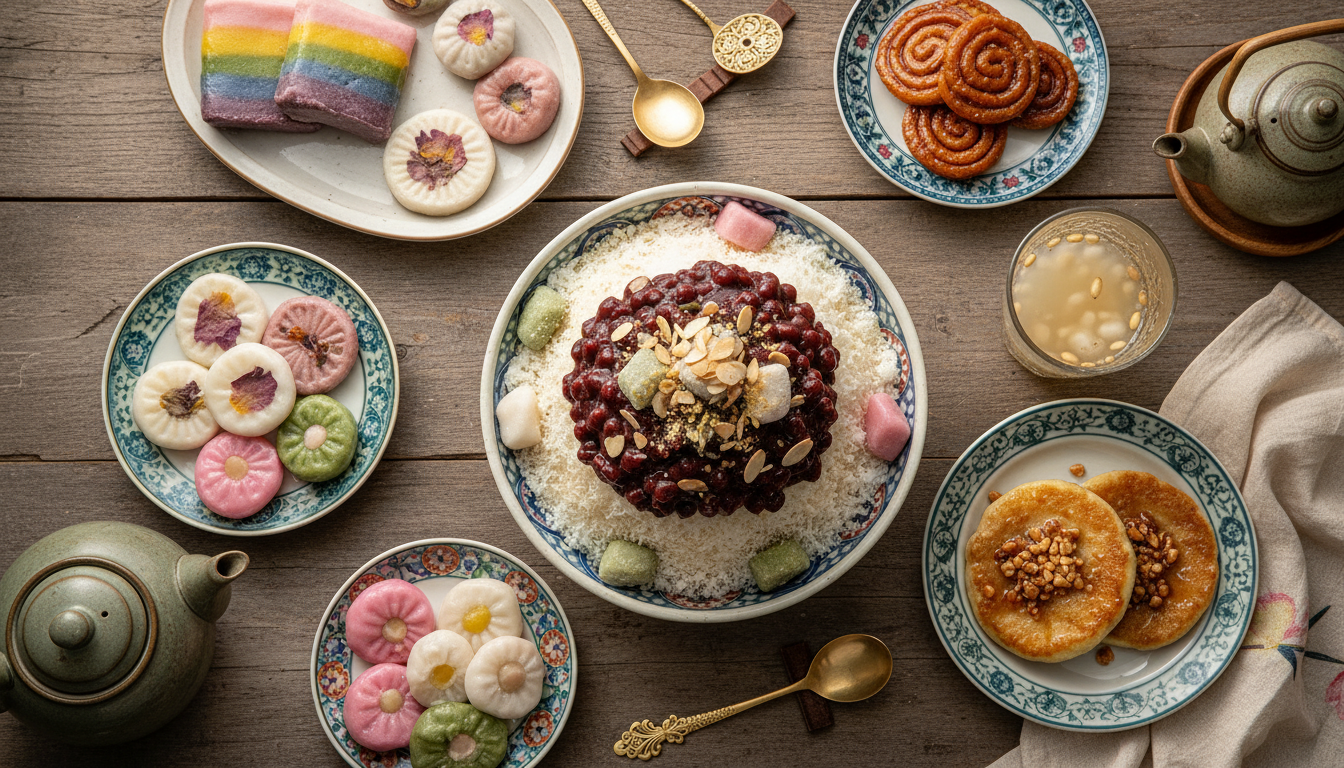
Bingsu is perhaps the most internationally recognized Korean dessert, and for good reason. Unlike a snow cone, bingsu uses ultra-fine shaved milk ice that melts on your tongue like snow. The classic version — patbingsu — is topped with sweet red bean paste (patso), rice cake pieces, condensed milk, and fresh fruit.
According to historical records, bingsu dates back to the Joseon Dynasty, when ice was a luxury reserved for royalty. Today, modern bingsu shops serve inventive versions: mango bingsu, matcha bingsu, strawberry bingsu, and even injeolmi bingsu dusted with roasted soybean powder. If you’re a fan of cold desserts, bingsu is the ultimate summer treat — and it’s available year-round at Korean cafes.

2. Tteok (떡) — Korean Rice Cakes
Tteok is the cornerstone of Korean dessert culture. Made by steaming or pounding glutinous rice flour, tteok comes in hundreds of varieties. Songpyeon (half-moon shaped rice cakes filled with sesame or red bean) are made for Chuseok (Korean Thanksgiving). Injeolmi is a chewy rice cake rolled in roasted soybean powder with a nutty, earthy flavor. Gaetteok is simply grilled over flame until crispy outside and chewy inside.
The texture of tteok is similar to mochi — and if you love our guide to mochi, you’ll find tteok equally fascinating. Both are made from rice flour, both are chewy and satisfying, and both come in sweet and savory forms. The key difference is that tteok recipes vary enormously by region, season, and occasion in Korea — it’s a living culinary tradition, not just a single dish.

3. Hotteok (호떡) — Korean Sweet Pancakes
Hotteok is one of the most beloved Korean street foods — a thick, doughy pancake with a molten brown sugar, cinnamon, and walnut filling that oozes out when you bite in. It’s cooked on a flat griddle and pressed with a special tool to create a perfectly crispy exterior with a gooey center.
If you’ve ever walked through a Korean winter street market, you’ve likely smelled hotteok before you saw it. The caramelizing sugar and warm spices create an irresistible aroma. A modern variant, 씨앗 핫도그 hotteok, is filled with a savory-sweet seed mixture. Another popular spin fills hotteok with glass noodles for a savory version. Either way, it’s a dessert that needs to be experienced warm — ideally straight off the griddle.

4. Yakgwa (약과) — Korean Honey Cookies
Yakgwa translates to “medicine candy” — a name that reflects its historical use as a health tonic. These beautiful diamond or flower-shaped cookies are made from wheat flour, sesame oil, ginger, and rice wine, then deep-fried and soaked in honey syrup. The result is a dense, chewy, intensely aromatic cookie with a honeyed glaze.
Yakgwa has seen a massive revival in recent years, particularly among younger Koreans who appreciate its artisanal quality and complex flavor. They’re commonly served at traditional ceremonies, ancestral rites, and holiday gatherings. You’ll also find yakgwa at high-end Korean dessert cafes paired with traditional teas. Their sweetness is deep and rounded rather than sharp — making them perfect for pairing with bitter green tea or barley tea.
5. Sikhye (식혜) — Traditional Korean Rice Punch
Sikhye is a chilled, lightly sweet rice beverage that functions as a dessert drink. Made by fermenting cooked rice with malt water, sikhye has a mild, clean sweetness with floating rice grains that have softened to a tender chew. It’s served cold and is traditionally a digestive drink served after large Korean meals.
Sikhye is particularly beloved in winter, often drunk after holiday feasts like Seollal (Korean New Year) and Chuseok. You can find it canned in Korean grocery stores, but homemade sikhye — slowly fermented and chilled overnight — is infinitely better. Think of it as Korea’s answer to a dessert smoothie: light, refreshing, and just sweet enough.
6. Jeon (전) — Sweet Korean Pancakes
While jeon is often a savory dish, the dessert version — hwajeon (flower pancakes) — is one of Korea’s most visually stunning treats. These small, delicate pancakes are made from glutinous rice flour and decorated with edible flowers: azaleas in spring, chrysanthemums in autumn. The flowers are pressed into the dough before pan-frying, creating an elegant, naturally sweet pancake.
Hwajeon is historically associated with Korean scholars and aristocrats who would gather in nature for poetry sessions and flower-viewing picnics. Today they’re made for special occasions and seasonal celebrations. If you enjoy delicate, elegant desserts with visual impact, hwajeon is a beautiful project to try at home.
7. Bungeoppang (붕어빵) — Fish-Shaped Waffle Cakes
Bungeoppang — literally “crucian carp bread” — is a fish-shaped pastry with a crispy waffle-like exterior and a sweet filling. The classic filling is sweet red bean paste (anko), though modern versions include custard cream, Nutella, sweet potato, and even pizza. These are pressed in fish-shaped iron molds, creating their unmistakable shape.
Bungeoppang is the quintessential Korean winter street food. They’re sold from wheeled carts all over Korea from October through March, filling cold streets with the warm smell of baking batter. In Japan, a nearly identical treat exists called taiyaki — but bungeoppang is distinctly Korean in its regional flavors and street food culture context.
8. Dalgona (달고나) — Korean Toffee Candy
Before dalgona coffee went viral globally in 2020, dalgona was a beloved Korean street candy. Made from just sugar and baking soda heated in a small ladle, dalgona forms a brittle honeycomb-like toffee. Street vendors would press it into shapes and challenge buyers to carefully break out the shape without cracking it — those who succeeded got a free candy.
Dalgona’s worldwide fame through the Netflix series Squid Game brought this simple candy to global attention. You can make it at home in minutes with just two ingredients, and it tastes like a light, airy caramel with a slight bitter edge from the baking soda. It’s as fun to make as it is to eat.
9. Patbingsu (팥빙수) — Red Bean Shaved Ice
While we covered bingsu broadly above, patbingsu deserves its own spotlight as the original, most classic bingsu. “Pat” means red bean in Korean, and patbingsu is built around sweetened red bean paste (danpatso) as the primary topping. A traditional bowl includes shaved ice, red bean, rice cake pieces (tteok), and condensed milk — simple, traditional, and deeply satisfying.
Red bean — also called azuki bean — is one of the most important ingredients in East Asian desserts. In Korean cuisine, it appears in bingsu, tteok fillings, sikhye, and street foods like bungeoppang. Its natural sweetness and dense, creamy texture make it a perfect dessert base. If you’ve never tried red bean paste, patbingsu is the ideal introduction.
10. Gyeongdan (경단) — Korean Rice Cake Balls
Gyeongdan are small, round rice cake balls made from glutinous rice flour and boiled until tender, then rolled in a coating. The coating options are endless: roasted soybean powder (kong garu), sesame seeds, dried jujube powder, mung bean powder, or even shredded coconut. Each version has a distinct flavor and color, making gyeongdan one of the most visually striking Korean sweets.
The texture is similar to Japanese mochi but slightly denser and chewier. Gyeongdan are served at ancestral rites, weddings, and seasonal festivals. They’re a beautiful example of how Korean dessert tradition elevates simple ingredients — rice flour and natural coatings — into something elegant and ceremonially significant.
11. Hangwa (한과) — Traditional Korean Confections
Hangwa is the collective term for traditional Korean confections — an umbrella category that includes yakgwa, dasik (pressed tea cakes), jeongwa (candied fruits), suksilgwa (cooked fruit desserts), and yumilgwa (oil-and-honey sweets). These are the aristocratic desserts of Joseon-era Korea, served at royal courts, ceremonies, and high-end banquets.
Today, hangwa artisans — called hangwa jang — are considered masters of Korean culinary heritage. Their work is painstaking: some hangwa pieces take days to prepare, involving multiple stages of cooking, pressing, drying, and coating. If you visit Seoul, a hangwa tasting at a traditional tea house is one of the most culturally immersive food experiences you can have.
12. Misugaru (미숫가루) Dessert Drinks
Misugaru is a roasted multi-grain powder blend — typically including rice, barley, black sesame, black bean, and various other grains — that’s mixed with cold milk or water and sweetened with honey or sugar. The result is a thick, nutty, satisfying dessert drink that functions like a Korean grain smoothie.
Misugaru has been a Korean health food staple for centuries, prized for its nutritional density. As a dessert drink, it sits somewhere between a milkshake and a smoothie — deeply flavored with a complex, roasted earthiness that’s uniquely Korean. It pairs beautifully with tteok or yakgwa as a dessert course. If you’ve explored dairy-free alternatives in baking, misugaru is a natural next step to explore.
13. Kkwabaegi (꽈배기) — Korean Twisted Donuts
Kkwabaegi are twisted fried dough sticks — Korea’s answer to a churro or a Chinese youtiao, but distinctly Korean in flavor. The dough is made from glutinous rice flour, giving it a chewier texture than a typical Western donut. After frying until golden, they’re coated in cinnamon sugar or plain sugar and served warm.
The twisted shape isn’t just aesthetic — it creates more surface area for the dough to fry evenly, producing a crispy exterior with a chewy, slightly stretchy interior. Street stalls throughout Korea serve kkwabaegi fresh and hot. If you enjoy our matcha churros recipe or Bavarian cream churros, kkwabaegi represents a fascinating cultural parallel worth exploring.
14. Yeot (엿) — Traditional Korean Taffy
Yeot is one of Korea’s oldest confections — a chewy, sticky taffy made by slowly reducing grain (typically rice or sweet potato) with malt until thick, sweet, and amber-colored. Garae-yeot is the long, stick-shaped version, sold wrapped in sesame seeds. Yeot can be soft and pliable or brittle and hard depending on how far it’s cooked.
Yeot has deep cultural significance in Korea — it’s traditionally given to students before exams as a good luck gift, symbolizing “sticking to success.” It also appears in folk sayings. In terms of flavor, yeot is deeply caramelized and malty, similar to American molasses candy but with a more complex grain character. It’s a must-try if you encounter it at a Korean market.
15. Matcha and Makgeolli Desserts — Modern Korean Fusion
Korea’s contemporary dessert scene has embraced global ingredients and fused them with traditional techniques. Matcha-flavored tteok, makgeolli (rice wine) rice cakes, black sesame soft-serve, and yuzu cheesecakes have all become staples at modern Korean dessert cafes. Seoul’s Insadong and Hongdae districts are packed with concept cafes serving these inventive hybrids.
Korean dessert culture has also embraced Western formats — croissants with Korean fillings, dalgona lattes, and Korean-style cheesecakes with a jiggly, cotton-soft texture that differs from New York-style cheesecakes. If you enjoy no-bake cheesecakes or Oreo cheesecakes, Korean-style cotton cheesecake is a next-level variation worth trying. The fusion dessert movement in Korea shows no sign of slowing — it’s one of the most creative dessert scenes in the world right now.
How to Find Korean Desserts Near You
Korean desserts are increasingly available outside Korea. H Mart, Lotte Mart, and Korean grocery stores nationwide stock packaged tteok, canned sikhye, yakgwa, and misugaru powder. Korean bakeries and dessert cafes have proliferated in major cities — search for bingsu cafes, Korean snack bars, or Korean pastry shops near you.
For making Korean desserts at home, glutinous rice flour (mochiko or chapssal garu) is the essential ingredient. It’s available at Asian grocery stores and increasingly at mainstream supermarkets. Red bean paste (anko or danpatso) is another staple that’s widely available canned or in pouches. With these two ingredients and a little patience, you can make tteok, gyeongdan, and even a basic patbingsu at home.
FAQ About Korean Desserts
What is the most popular Korean dessert?
Bingsu (shaved ice) is arguably the most popular Korean dessert internationally, while tteok (rice cakes) holds the deepest cultural significance domestically. Hotteok and bungeoppang are the most beloved Korean street food desserts.
Are Korean desserts healthier than Western desserts?
Many traditional Korean desserts use less refined sugar and fat than Western counterparts. Ingredients like red bean, sesame, and grain powders add fiber and nutrients. However, modern Korean desserts like bingsu with heavy toppings or fried street foods like hotteok can still be high in calories — it depends on the specific dessert.
Is tteok the same as mochi?
Tteok and mochi are both made from glutinous rice flour and share a similar chewy texture, but they’re distinct traditions. Korean tteok has hundreds of regional varieties with different cooking methods (steaming, pounding, pan-frying), while Japanese mochi typically refers to a specific type of pounded rice cake. Both are delicious — and both are explored in our What Is Mochi guide.
Where can I buy Korean desserts?
Korean desserts are available at H Mart, Lotte Mart, and Korean grocery stores nationwide. In major cities, dedicated Korean dessert cafes and bakeries serve bingsu, tteok, and hotteok. Many packaged Korean desserts (tteok, sikhye, yakgwa) are also available on Amazon and Asian grocery delivery services.
Can I make Korean desserts at home?
Absolutely. Most Korean desserts require minimal equipment. Hotteok needs just a pan and a few pantry staples. Dalgona candy requires only sugar and baking soda. Tteok requires glutinous rice flour and a steamer. Bingsu is achievable with a basic blender or food processor if you don’t have a shaved ice machine. Start with hotteok or dalgona for the easiest entry point into Korean dessert making.